
Internal Guerilla Test with Alias
Guerilla testing in semi-public places such as cafés and malls can be a tall order if you represent a large commercial organization. Testing re-skinned prototypes on co-workers from other departments provides a great alternative.
Working with UX at a big company provides a lot of opportunities for user testing. There is generally more time, bigger budgets and a large base of customers to reach. However, it also comes with a few drawbacks. I have found that working for a big commercial organization entails less goodwill when wanting to conduct quick-and-dirty guerilla tests in semi-public places such as cafés and shopping malls.
Kicked out of Fisketorvet
A while back me and my team set out to guerilla test a user interface for a customer service hub to get some fast feedback on a simple prototype. We were looking to talk to random, unbiased people and Fisketorvet – a shopping mall in Copenhagen closely located to our office – seemed like the ideal place to go to talk to our target customers. However, it turns out that Fisketorvet has a strict ‘No surveys, petitions or the likes’ policy, so we were kindly asked to leave the premises by one of the mall security guards.

Thinking about it that really does make a lot of sense. These guys obviously don’t want their commercial interests (giving people a nice shopping experience) to be disturbed by another big company’s commercial interests without being compensated. In this case I believe students and startups are more likely to get extraordinary permission for seeking out potential user test subjects these places out of sheer goodwill.
Guerilla testing is a really appealing method in an agile mindset. It allows us to get feedback from real users early and often. So I set out to find a way of circumventing the goodwill problem.
Random people right next door
It turns out that another advantage of working at a large company is that it has a lot of employees who are not directly related or involved to the design of digital interfaces. At my company there are at least 1.000 other people on-site with very different professions and backgrounds. So guerilla testing internally would make it possible (and extremely convenient) to find random people – but not unbiased ones. Although the employees from the reception, the mail office, the canteen etc. are regular people with no special interest in technology and design, they are still part of the same company and would be biased towards having a positive attitude towards the brand and not wanting to criticize the work of fellow employees. This bias would most likely lead to invalid test results.
Un-biasing your co-workers
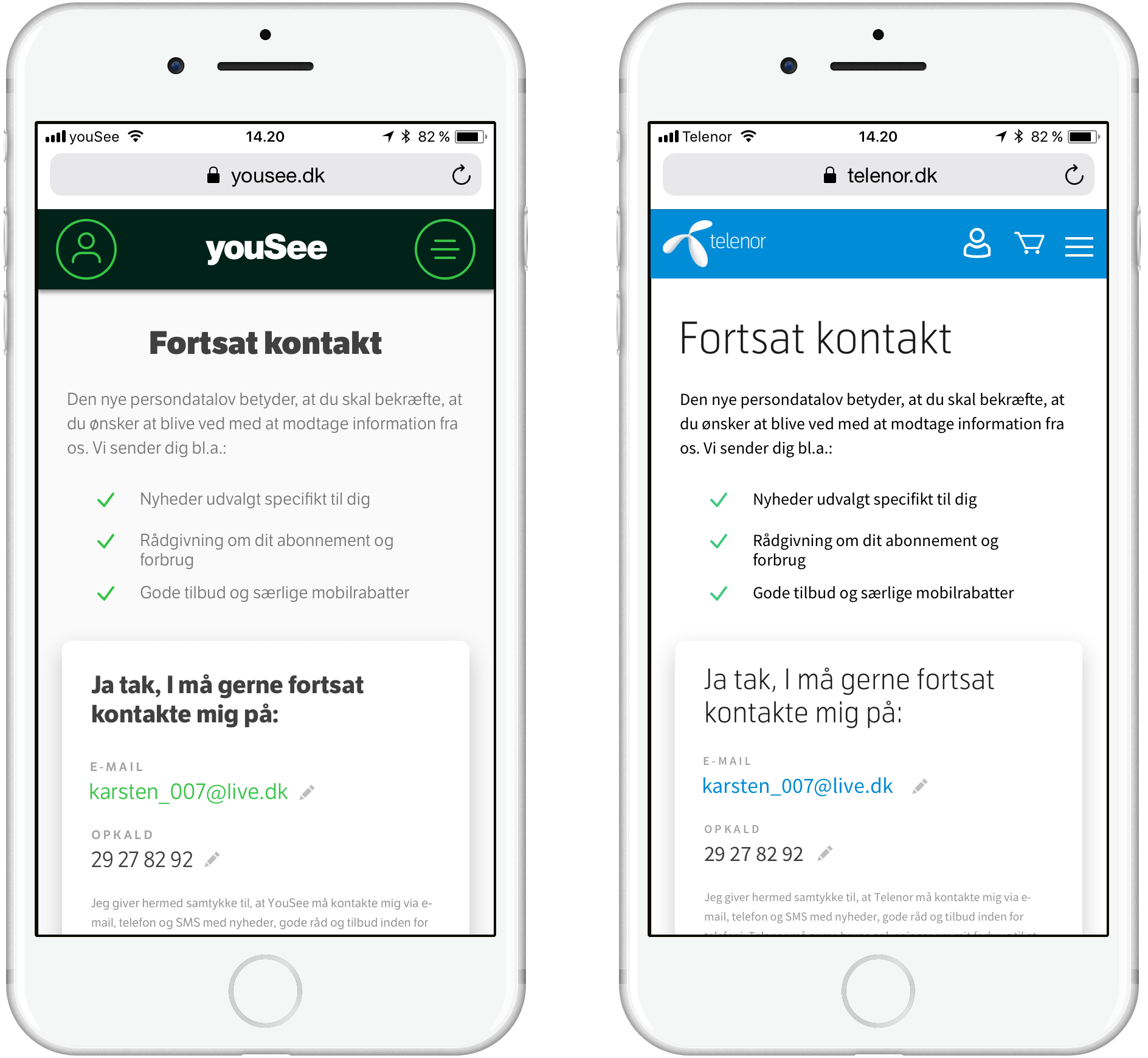
Being asked to quickly user test a permission form as part of the GDPR hysteria, I started thinking of ways to circumvent the internal bias problem. What if we were to strip the iser interface of any brand recognition, basically going back to wireframes – I thought to myself. That would most likely cause a problem for the immersion of the user test. Getting honest and candid feedback requires a realistic façade (GV Design Sprint logic). This led me to the idea that simply re-skinning our prototype to look like another company would fix the issues. Re-skinning the interface to look like that of a competitor might even allow us to get more candid feedback. So that’s exactly what I did with the help of my side-kick and UX intern Mads. Re-skinning the prototype by imitating the CVI of one of our main competitors – Telenor – was fast since it was only a matter of styling. Here’s the resulting change:
2 hours – 17 actionable insights
When the prototype was built and the interview guide written and printed me and Mads set out to walk around our headquarters interviewing random people from departments we didn’t know existed. On our way we talked to co-workers from the post office, management, marketing, entertainment content and a woman who happened to have an accessory stand in our hallway. All in all we got ten responses in a matter of around two hours. Some of the people we talked to were a bit bewildered that we were testing a Telenor interface on the premises but it didn’t seem to disturb them in carrying out the tasks or giving candid feedback. On fact the people we talked to were very honest giving critical feedback about their experience. We ended out with 17 insights of the things that were generally understood by the users and the things which didn’t work and needed to be redesigned.
Great tool under certain circumstances
As with any method this one has its strengths and weaknesses. This type of test worked out well in this particular example. The purpose of the interface was very generic in a way that any company could have been behind it, so it was easily re-skinned. Testing internally is also only possible in large organizations where the employees of the company are representative of its target customers – which just so happens to be the case at my company. I’ve added the method to my own toolbox and will definitely consider using it the next time we need quick-and-dirty feedback on an early prototype.
Maybe you’ve tried something similar and have some good practical advice to share? Feel free to leave a comment below if you have any feedback, questions or suggestions.
Cover image credits: Adelina Voinea & Tom Ingebretsen from the Noun Project